

125kW 52kWh 170PS Technik 5dr Auto

.jpeg)


.jpeg)
.jpeg)
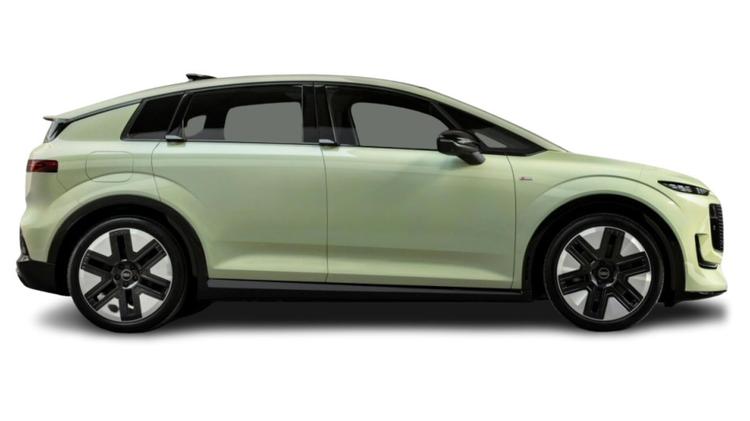


Audi redefines its A2 model for the new EV era. Jonathan Crouch takes a look.
If you've been waiting for a small electric Audi for some time, you might expect it to be cutting-edge and futuristic. What you might not expect is for it in name and look to draw heavily on a cult classic Ingolstadt model from the turn of the century. But that's what we got in the shape of the Audi A2 e-tron. The original A2 of 1999 isn't a model the brand references very much because it sold for just five years and was a financial failure. But its aluminium space frame and radical aerodynamics broke new boundaries for its time and the fact that there's never been another small hatch like it since has seen that A2 remembered fondly. The A2 e-tron is styled exactly as a second generation version of its predecessor might look, but in truth it's a very different kind of product. Under the skin, it can't be as cutting-edge because this time round Audi's got to make money on it. So all the engineering is borrowed from a Volkswagen ID.3 Neo, while inside, much is lifted from other Ingolstadt models. Yet there's still just enough about the car to make it feel deliciously different - as we're going to see.
In one sense, you might think that the drivetrain technology of this Audi is the least progressive thing about it because there's nothing here we haven't seen before. But just because all the engineering you can't see is borrowed from a Volkswagen ID.3 Neo (and other similar VW Group CUPRA, Skoda and Audi models) doesn't mean it isn't reasonably cutting-edge. It's all built into the Group's usual rear-driven MEB platform for electric models of this size. And there's a choice of four drivetrains paired with permanent magnet synchronous motors. Most customers will be focusing on frugality and choosing between a couple of LFP batteries mated to the VW Group's latest APP350 rear motor. Either a 52kWh pack with 170PS, where there's 350Nm of torque, 0-62mph takes 8.8s and there's 261 miles of EV range. Or, alternatively, there's a 61kWh pack with a 190PS motor which doesn't go much faster but gives you up to 310 miles of range. If driving range is your priority and there's more in the budget, then your Audi Centre is going to want you to consider the biggest battery, which instead of lithium-iron-phosphate uses nickel-manganese-cobalt (NMC) chemistry. It's 84kWh in size, works with a 231PS motor and delivers up to 397 miles of range. It's also possible to get this big battery paired with the upgraded AP550 motor from the Volkswagen ID.Polo GTI. This develops quite a potent 326PS and with 345Nm of torque, propels this top A2 e-tron to 62mph in just 5.7s. Range is rated at 386 miles. As with the identically-engineered Volkswagen ID.3 Neo, across the line-up there are three different brake regen settings, as well as an auto regen function. Customers can choose between comfort or sports suspension set-ups. And adaptive dampers are available as an option. The rear wheel drive format delivers a tight urban turning circle. And expect that slippery shape to deliver exemplary cruising refinement.
It's actually rather strange that we haven't had a small car looking like the A2 for a quarter of a century, because if you optimise aerodynamics in a compact hatch, something A2-shaped is kind of what you end up with. Most notably the teardrop shape with its 'Kammback' rear end, plus the split tailgate screen, arcing roof line and blanked-off grille. This modern full-electric interpretation of 'A2-ness' though, is a bit bigger than the previous one (thanks to the dimensions of the MEB platform beneath), measuring about 4.3-metres long. It's also sleeker, with 0.24Cd drag coefficient, helped by a smooth underbody, small fins in the wheel arches, an active aero duct in the front bumper, contoured panels on the C-pillars and multi-slot alloy wheels. You might think the strange door handle arrangement with its protruding black stalks to be also dictated by aerodynamics, but it's really just there as an expression of technology. You put a finger into a panel recess and a capacitive switch releases the door. It's all a bit less avant-garde inside, where the fascia top twin screen panel is pretty much the same as in other recent smaller Audis. But the upholstered dashboard is strikingly stepped and makes copious use of a smart recycled fabric called 'Softwrap'. Behind the steering wheel, the blocky indicator/drive shift column introduced with the current Q3 makes another appearance and there are paddles for the brake regen settings. An 11.9-inch driver's display is paired with a curved 12.8-inch central touchscreen that can be configured to take Microsoft Teams calls and emails on the move. And you can have an augmented reality head-up display. It's a practical cabin with central stowage area big enough for a bag and a shelf with wireless charging for two smartphones. But Audi still hasn't got the message (now acknowledged by partner Volkswagen) about getting rid of haptic buttons from the steering wheel. The rear seat is spacious by class standards - head and knee room are generous. Various attachments can be clipped in around the interior, including a cupholder at the rear and attachment points in the boot that couple with a tension strap and a bag to hold the charging cables. The cargo area is 396-litres in size, or 1,336-litres with the rear bench folded, and can include a power outlet for V2L charging electronics.
Prices start from £32,200 and you can reduce that figure by £1,500 with the aid of a government grant - so think £30,700 as a starting point. For reference, Audi's combustion A3 family hatch starts from £28,650. And the car this A2 shares its EV engineering with, Volkswagen's ID.3 Neo, starts from £31,580 after government grant deduction. Think around £35,000 upwards once you specify the kind of A2 you'd ideally want. Choose your wheels carefully for optimum range (sizes are between 18 and 20-inches). Audi says that the most efficient configuration is the 19-inch set-up with aerodynamically optimized wheels, in which the wheel and tyre are specifically matched to each other. You might also want to look at the optional 'adaptive cruise assist plus with emergency assist' system that combines adaptive cruise control with active lane guidance at speeds of up to 130mph. The system can change lanes on highways by itself when the turn signal is triggered. As an additional feature, adaptive cruise assist plus enables the vehicle to brake automatically at red lights for the first time, coming to a complete standstill at the stop line. If the vehicle is not yet at a stop before the traffic light turns green, the system automatically continues driving. There are two sound system options as an alternative to the standard seven-speaker audio set-up. The optional Audi sound system with eight speakers includes a subwoofer and delivers 220-watts. The top-tier offering is the optional Sonos premium sound system with 14 high-performance speakers, including a subwoofer, as well as 15 amplifier channels and 660-watts of maximum amplifier power. Speakers near the C-pillar create a surround sound experience. In addition, it's possible to supply power to external devices - from electric barbeques to e-bikes - with an output of up to 3.6kW directly from the high-voltage battery using the vehicle-to-load function. Owners will now be able to control their A2 using a Digital Key feature on their smartphones.
There are lots of efficiency headlines here. Audi says that the 61kWh version can manage an uber-impressive 5.13 miles-per-kWh. The least cutting-edge thing about this A2 though, is its DC charging speed. Audi wants to highlight a 183kW charging figure, but that only applies to the top 84kWh NMC battery few will choose (only 79kWh of which is actually usable). The mainstream 190PS model's 61kWh LFP battery (58kWh usable) can only charge to just 105kW. The base 170PS 52kWh variant (50kWh usable) can only DC-charge to 100kW. On the plus side, the LFP chemistry used in the two base batteries is happy to be charged to 100% all the time. Out and about, with a 100kW rapid charger, around 180 miles-worth of electricity can be taken on board in just 30 minutes. The 52kWh version needs 24 minutes for a 10-80% DC charge; with the 61kWh version, it's 26 minutes - or 29 minutes for the two 84kWh variants. The car's e-tron route planner predictively schedules charging stops and conditions the battery in advance to ensure maximum charging capacity. It considers traffic conditions, route topography, and the availability and output of charging stations in real time. As needed, the smart range manager can suggest an alternative route with fewer charging stops by adjusting the recommended driving speed. It also displays the maximum speed at which the current route, including the planned charging stops, can be reliably completed. As usual with an EV, around 80% of charging will be done via programmable overnight replenishment using owners' garage wallboxes. With the 58kWh version, a 7.4kW wallbox will charge the car in 9 hours 15 mins (12 hours 15 mins for the 79kWh version). As always with any EV, you'll also make savings in BiK payments (rated at 4% until April 2027) then 5% in the '27 to '28 tax year and 7% in the '28 to '29 tax year. And as usual with an EV, the battery pack is warrantied to have at least 70% of its usable capacity after eight years or 100,000 miles.
The few who will remember the original A2 won't find this modern-era electric version as groundbreaking or charismatic. But some of the customers Audi is aiming at here - those who want something more distinctive and cutting-edge in a high quality small EV - may find in this A2 e-tron much of what they're looking for. We wish it wasn't quite so reliant on the VW Group parts bin and could be more bespoke, but in volume models, those days died with the original A2's failure. Ingenuity these days is found in less fundamental features, a number of which this A2 e-tron has. Audi calls this 'not only a beautiful car but a beautiful power bank'. And if a power bank can be beautiful, this is perhaps what it looks like.
+ initial rental
Processing Fee: £ inc VAT
99kW V1 37kWh 5dr Auto
£227.05 inc VAT
Initial rental: £2,724.55 inc VAT
£189.20 + VAT
Initial rental: £2,270.45 + VAT
155kW 55 SE L 55kWh 5dr Auto
£229.42 inc VAT
Initial rental: £2,752.99 inc VAT
£191.18 + VAT
Initial rental: £2,294.16 + VAT
220kW 82kWh Long Range Single motor Prime 5dr Auto
£353.49 inc VAT
Initial rental: £4,241.91 inc VAT
£294.58 + VAT
Initial rental: £3,534.93 + VAT


.jpg)